
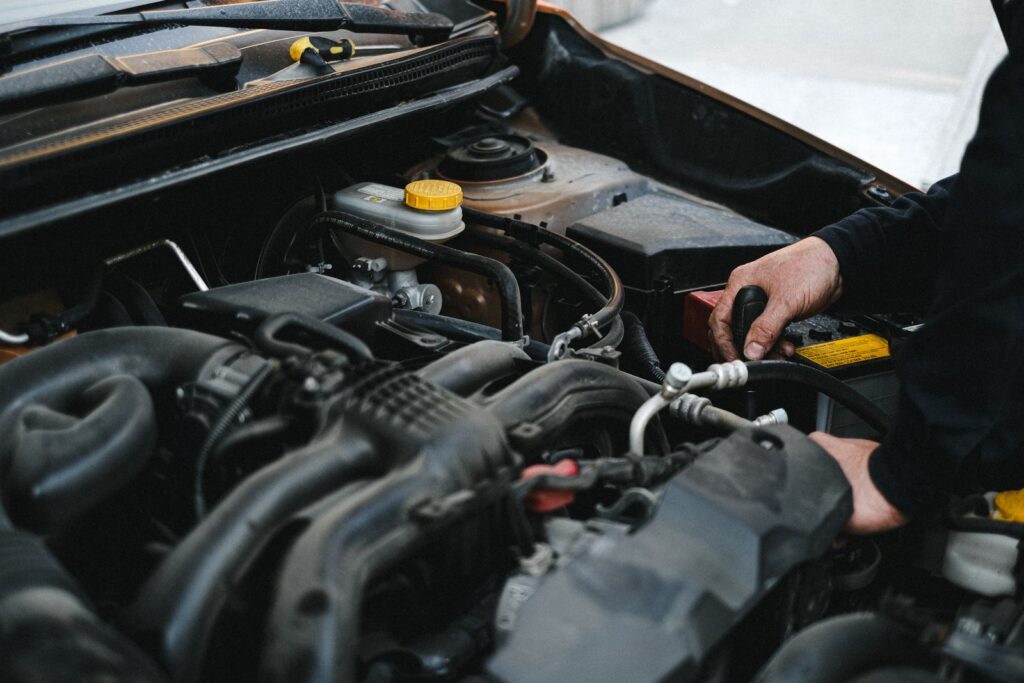
What Halfords actually stocks for a service
The starting point for most drivers is the shelf. Larger Halfords stores typically carry the consumables that make up a basic service, including engine oil, oil filters, air filters, pollen and cabin filters, spark plugs, brake pads and discs, brake fluid, coolant, screen wash and batteries. Bulbs, wipers and batteries are among the most commonly stocked items because they are the parts people often need immediately.
The wider catalogue is where it gets more interesting. Order online or through the store and you may be able to access a wider range including timing belts and kits, water pumps, alternators, starter motors, suspension components and clutch kits, though availability varies. Availability also depends on the vehicle and the store, so treat shelf stock and orderable range as two different things. A branch might not hold a front disc for your car, but the central warehouse often will.
It also helps to separate parts from accessories. Roof bars, mats and dash cams sit in a different category from service items, and the compatibility tools are built around the latter.
How to find the right parts for your car
The quickest route to the correct fitment is the registration lookup on the Halfords website. Enter your reg and the site narrows the catalogue to parts listed as compatible with that vehicle. It is far more reliable than searching by model name, because a single model year can span several engine codes, trim levels and braking setups.
Use the reg lookup as a starting filter, not the final word. Before you buy, check the engine code, the year of manufacture and the trim. Brake discs and pads in particular can differ between a standard model and a sportier trim, and a part that fits a 1.4-litre petrol may not fit the 1.6 diesel of the same generation. If a listing is flagged as special order, it usually means the part is not held in store and will be sourced from a supplier, so allow extra time and confirm the returns position before committing.
When you are unsure, the part number on the existing component is the most reliable reference you have. Photograph it before you order.
Brands, quality tiers and OEM versus aftermarket
Halfords mixes its own-brand ranges with established aftermarket names. Its own-brand parts are generally positioned as good-value equivalents, while branded lines from recognised manufacturers sit alongside them at a higher price. The practical difference between tiers usually comes down to materials, tolerances and expected service life rather than a dramatic gap in basic function.
The term to understand is OEM, or original equipment manufacturer. An OEM-standard part is made to meet the specification the car maker set, even though it is not sold in a branded box. Many aftermarket suppliers make parts to that standard, and some make the original parts themselves. What matters is whether the part meets the manufacturer’s specification for your vehicle, not whether it carries a particular logo. For safety-critical components such as brakes and suspension, that distinction is worth checking carefully.
Buying parts on their own or with fitting
Halfords gives you three routes. You can buy online for home delivery, order for click and collect at a store, or book the part with fitting at a Halfords autocentre. Fitting makes most sense for jobs where the labour is awkward or the safety stakes are high: batteries on modern cars with coded electronics, brake pads and discs, and anything requiring the car to be raised and supported.
The key point on cost is that the part price and the labour charge are separate. A battery might look cheap on the shelf, but fitting, registration and disposal of the old unit add to the total. Brake work is quoted as parts plus labour, and the labour rate varies by centre and by job. Always ask for the fitted price rather than comparing a shelf price against a garage quote, because they are not like for like. If you would rather hand the whole job to a garage, it is worth comparing local car garages on labour rates, reviews and warranty terms before you buy parts yourself.
Halfords car service parts versus independent motor factors
Independent motor factors compete on depth and trade relationships. A good factor will hold or source a wider range of brands, offer trade accounts with tiered pricing, and often stock parts for older or less common vehicles that a general retailer will not carry. Opening hours vary, but many factors open early specifically to serve garages and trade customers.
Halfords competes on convenience, nationwide coverage and clear pricing for retail customers. If you need a part today and you are near a large store, that convenience has real value. If you are rebuilding a braking system or chasing a specific brand, a factor or specialist supplier will usually serve you better. For certain jobs, particularly on newer cars with complex electronics or manufacturer-specific software requirements, a main dealer part is the better call because the aftermarket equivalent may not be fully compatible.
Parts for DIY servicing and warranty considerations
If you service your own car, keep every receipt and note the part numbers and the mileage at the time of fitting. A new car warranty cannot be invalidated simply because servicing was carried out outside the dealer network, provided the work is done to the manufacturer’s schedule and the parts used meet the manufacturer’s specification. Skip either of those and a warranty claim on a related failure becomes much harder to argue.
This is where buying the right grade of part pays off. A cheap filter or oil that does not meet the specified standard can be a false economy if it later becomes the reason a claim is refused. Match the specification in your handbook, not just the dimensions of the part you are replacing.
Common mistakes when buying service parts
One trap is ignoring whether a part is handed, which catches people out on wipers, brake calipers and some suspension components where left and right are not interchangeable. Another is mixing up service intervals for different fuel types, since diesel and petrol models often have different oil specifications and change periods. A physically identical sensor or electronic component may also fail to communicate correctly with the car, so compatibility needs checking beyond the dimensions and the connector shape.
Where Halfords car service parts fit into your servicing plan
Think of Halfords as a strong option for convenience items and consumables: oil, filters, bulbs, wipers, batteries and the everyday parts you need without a wait. Its reg lookup and fitting service make it a genuinely practical choice for drivers who want one transaction and a fixed price.
For bigger jobs, weigh up the alternatives. Independent motor factors offer greater range depth and trade pricing, specialist suppliers carry the brands enthusiasts ask for, and main dealers remain the safest route for complex electronic components. Before you commit to any of them, compare what is available locally, check the warranty terms on the parts and the labour, and make sure the specification matches your car. The right part at the right price is worth a few minutes of checking.
1 comment
Comments are closed.